Marquette is a city in the U.S. state of Michigan and the county seat of Marquette County.[8]The population was 21,355 at the 2010 census, making it the largest city of the state’s Upper Peninsula. Marquette is a major port on Lake Superior, known primarily for shipping iron ore, and is the home of Northern Michigan University. In 2012, Marquette was listed among the 10 best places to retire in the U.S. by CBS MoneyWatch.
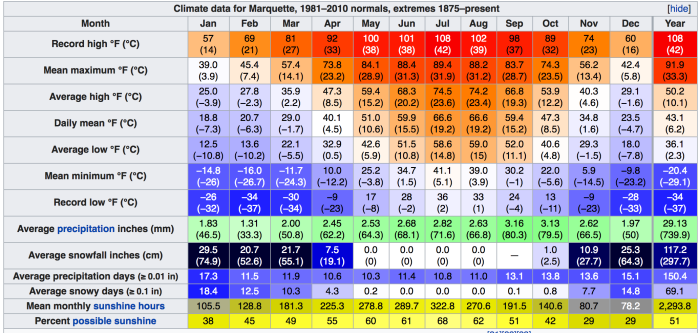
Marquette has a humid continental climate (Köppen climate classification Dfb) with four distinct seasons that is strongly moderated by Lake Superior and is located in Plant Hardiness zone 5b.[19] Winters are long and cold with a January average of 18.8 °F (−7.3 °C). Winter temperatures are slightly warmer than inland locations at a similar latitude due to the release of the heat stored by the lake, which moderates the climate.[20] On average, there are 11.6 days where the temperature reaches below 0 °F (−18 °C) and most days during winter remain below freezing.[21] Being located in the snowbelt region, Marquette receives a significant amount of snowfall during the winter months, mostly from lake-effect snow. Because Lake Superior rarely freezes over completely, this enables lake effect snow to persist throughout winter, making Marquette the third snowiest location in the contiguous United States as reported by the National Oceanic and Atmospheric Administration with an average annual snowfall of 149.1 inches (379 cm).[22] The snow depth in winter usually exceeds 10 inches (25 cm).[21]
The warmest months, July and August, each average 66.6 °F (19.2 °C), showing somewhat of a seasonal lag. The surrounding lake cools summertime temperatures[20] and as a result, temperatures above 90 °F (32 °C) are rare, with only 3.4 days per year.[21] Spring and fall are transitional seasons that are generally mild though highly variable due to the alternation of air masses moving quickly. Spring is usually cooler than fall because the surrounding lake is slow to warm than the land while in fall, the lake releases heat, warming the area.[20]
Marquette receives 29 in (737 mm) of precipitation per year, which is fairly evenly distributed throughout the year, though September and October are the wettest months with January and February being the driest. The average window for nighttime freezes is October 15 thru May 7.[21] The highest temperature ever recorded in Marquette was 108 °F (42 °C) on July 15, 1901 and the lowest was −33 °F (−36 °C) on February 8, 1861.[21] Marquette receives an average of 2,294 hours of sunshine per year or 51% of possible sunshine, ranging from a low of 29% in December to a high of 68% in July.


